Downward Causation
One approach which is put forward in an attempt to resolve the apparent incompatibility between physical determinism and freedom is based on systems theory and the concept of “downward causation”.
This is described in ways such as the following: Consider a complex system which can be divided into connected sub-systems such as an ant colony, or a human society. From the point of view of the sub-system, the overall system forces them to do certain things. So human society as a whole puts constraints on the behaviour of the individuals.
More generally, it is the way that the environment can constrain the behaviour of systems within it.
Connected with the concept of downward causation is the concept of emergence. Where we have a large number of elements which mutually influence each other through simple rules, it is often the case that large scale patterns are observed which would not be obvious from just considering these low level rules.
A very simple example of emergent behaviour is what happens when a number of positively and negatively charged particles are placed in a region of space with random initial velocities. Left to themselves they will move in accordance with Coulomb’s Law and, contrary to most people’s expectations, a stable ring-like configuration will eventually emerge.
A more complex example is a snowflake. Although the atoms which make up the snowflake follow the laws of physics, the application of these simple laws to a large number of connected elements, together with environmental boundary conditions, lead to large scale patterns which would not be obvious from looking at the simple rules.
Still more complex is what happens when a large number of humans are put in the same environment. There will be a tendency to form organised structures such as communities, villages, nations etc.
From this, some infer that “the higher-level system (ie. the broader, more complex system) exerts causal influences over its parts such that a complex system can be seen as (in part) its own cause”.[i, page 43] In other words a snowflake is partly its own cause.
This is seen as the result of constraints placed by the higher order system on what lower order systems can do. In other words the environment in which the lower order system exists presents constraints.
Murphy and Brown assert[93, page 48] that it “ought to be an obvious fact that agents are the causes of their own behaviour” and they talk about “self-directing systems”. As an example of the latter, they speak of the development of an organism’s jaw structure which is suited for use in its environment. A diagram of this “simple information-using and goal-directed system” is given in their Figure 2.4
However, despite appearances, there is no extra causal agency in this picture. This is expressed, for instance, in [ii], “In our view, the phrase ‘top-down causation’ is often used to describe a perfectly coherent and familiar relationship between the activities of wholes and the behaviours of their components, but the relationship is not a causal relationship.” There is no special way in which a large-scale structure or system can exert causative effects on it components in a way which cannot be described by the sum of all the interactions of the components on each other.
And:
“So I don’t think downward causation is of any help to attempts to free the phenomenon of consciousness from arising in a completely conventional way from the collective behavior of microscopic physical constituents of matter. We’re allowed to talk about consciousness as a real, causally efficacious phenomenon — as long as we stick to the appropriate human-scale level of description. But electrons get along just fine without it.”[iii]
In other words everything can be modelled without invoking consciousness or free will.
Emergence in a hierarchy of control loops []
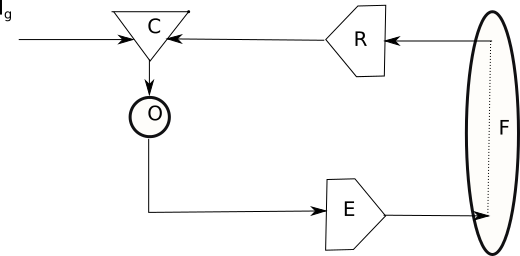
Consider a control loop such as the one shown above. This could be a thermostatically controlled room in which case, the effector would be a heater which could be on or off. The receptor would be a thermometer and the comparator, C, would determine whether the temperature was higher or lower than Ig and turn the heater on or off as appropriate. This system is described as exhibiting “downward causation” because the state of a sub-system, the heater, is controlled by the larger system including the environment and the setting of Ig.
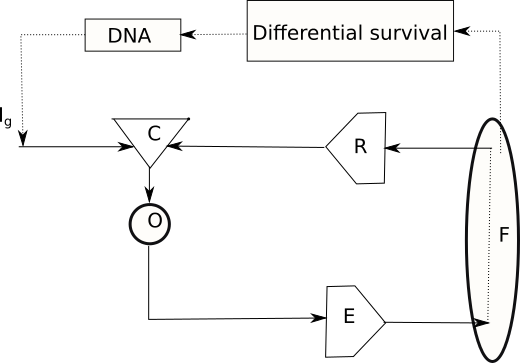
To take this one stage further, consider the thermostatic system which controls the temperature of the blood in an animal. Here, the desired temperature, Ig, has been set by natural selection. In an organism where Ig is set to a bad value, the organism dies, if it is set to a good value, the organism survives and that setting persists. The diagram can therefore be extended as shown in Figure 3. This too is considered to be an example of “downward causation in specifying the features of the DNA that result in the homeostatic mechanism within the organism having the goal state which it does”[93 page 70]. Nevertheless there is nothing here but the outworking of physical laws together with the outcome being interpreted by a conscious observer.
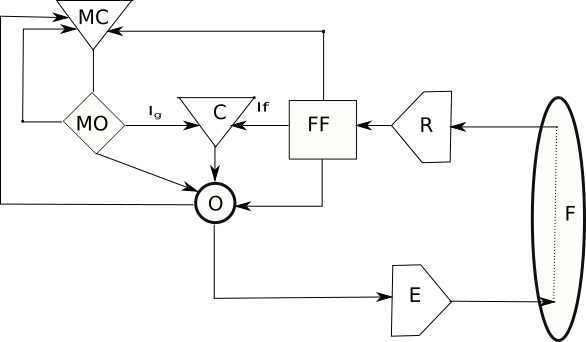
In [93 page 129/130] this process is taken further by wrapping another control system around the original one giving the system shown in Figure 4. Although the diagram is not fully explained in [93], it seems that the goal of the original system is set by the output of the outer system in order to achieve a higher level goal. Whether this is a higher order control system or a hierarchical system is unclear. However although we have a greater complexity and a greater number of internal degrees of freedom, there is nothing qualitatively new here.
This, notwithstanding the fact that it is possible to talk about parts of the system being “goal orientated” and other parts of the system “choosing” what those goals are going to be, the “choosing” is still just the result of optimising to solve a higher level goal, such as survival.
Clearly this process can be repeated as much as we can imagine giving ever more complexity and flexibility and the emergence of a greater and more complex amount of structure. The same comments stand in that there is still nothing qualitatively new nor any form of causation other than the combined effect of the components of the system following their own, locally imposed, laws. Nor can there be any without the introduction of some new type of component.
“No novel types of physical causes are evoked by this conception of emergence, only novel types of configurations and what might be described as configurational causes.” [iv] but also “offer an amendment to two major oversimplifications about the nature of causality, that causes have simple location and that causes always flow upward and outward in scale.”
An objection to the idea of downward causation [as being more than just a description of an assembly of low level interactions] is that “a level of organisation is not a thing but a set and therefore a concept … all talk of inter-level is elliptical or metaphorical.” Juarrero [v page 129] replies with the rather unconvincing statement that such an objection betrays the philosophers’ refusal to acknowledge self-cause as well as a tendency towards reification.
Emergence in an ant colony
A moderately complex example of emergence and top down causation is given as a harvester ant colony. Again, although it seems clear that while the complex and structured behaviour is the result of an assembly of low level interactions which are constrained by the overall system, there is no new causation here. These higher level constraints are nothing more than the combination of the low level interactions. An electrical circuit performs high level functions but few would dispute that these functions are the result of the sum total of interactions of the electrons and the environment despite appearances. The high level description is an approximation of the more detailed low level system. A very good approximation which means it is rarely necessary to analyse the behaviour of individual electrons, but an approximation nevertheless.
A strange statement on [93 page 96 ] is this: “The standard reductionist model assumes that the ants are like atoms, whose behaviour is determined solely by internal rules and whose characteristics are not affected by relations within the colony.” (my italics) However there is nothing to say that the behaviour is not affected by the rest of the colony just as the behaviour of the charged particles in the first example is affected by the existence of the other particles to produce a self-preserving ring.
Despite the claims, it appears that the bottom line is that the description of large system behaviour in terms of “downward causation” adds nothing new to the description in terms of a bottom up “reductionist” description, so long as all the interactions are taken into account. It is certainly possible, using the former approach, to speak of “goal-driven” behaviour where the goals are set by higher order controls with the final goal being that of survival. It is certainly amazing that such complexity should emerge in Nature but all we have is what would be called “weak emergence” whereby the structure which is observed is not obvious from the material and the rules of interaction but does not need any explanation apart from that. Moreover there is no radically new phenomenon which magically appears, such as agency or consciousness despite the fact that it is argued that it does.
In answer to its own question “Did my neurons make me do it?”, the answer given in [93 page 307] is “almost never”. However they have not shown that our neurons together with their configuration which is the result of environmental factors together with the low level laws of physics did indeed determine my actions, at least with a random component due to quantum effects and chaotic amplification.
The question remains unanswered.
iMurphy and Brown, “Did my neurons make me do it”, Oxford University Press, 2007, ISBN 978-0-19-921539-3
iiC. F. Craver and W. Bechtel, “Top-down causation without top-down causes”, Biology and Philosophy (2007) 22:547–563, DOI 10.1007/s10539-006-9028-8
iiiSean Carroll, “Consciousness and Downward Causation”, Posted on September 8, 2016, http://www.preposterousuniverse.com/blog/2016/09/08/consciousness-and-downward-causation/
ivTerrance Deacon, “Three levels of emergent phenomena”, in Nancy Murphy and William R. Stoeger (eds), Evolution and emergence, Systems, Organisms Persons (Oxford University Press, 2007) ch. 4
vAlicia Juarrero, Dynamics in Action: Intentional behaviour as a complex system, Cambridge Mass. MIT Press 1999.