The Rider and the Elephant
In his book, [Jonathan Haidt 2012] describes a number of experiments which show that many of our decisions and judgements which we believe are make consciously and rationally are in fact made intuitively and subconsciously under the influences of biases of which we are unaware. Our rational faculties take the intuitive judgement and find reasons for making the conclusion which we have already come to. In this view, conscious thought-processes serve as a kind of post hoc justification of our decisions. Sometimes very implausible justifications, at that.
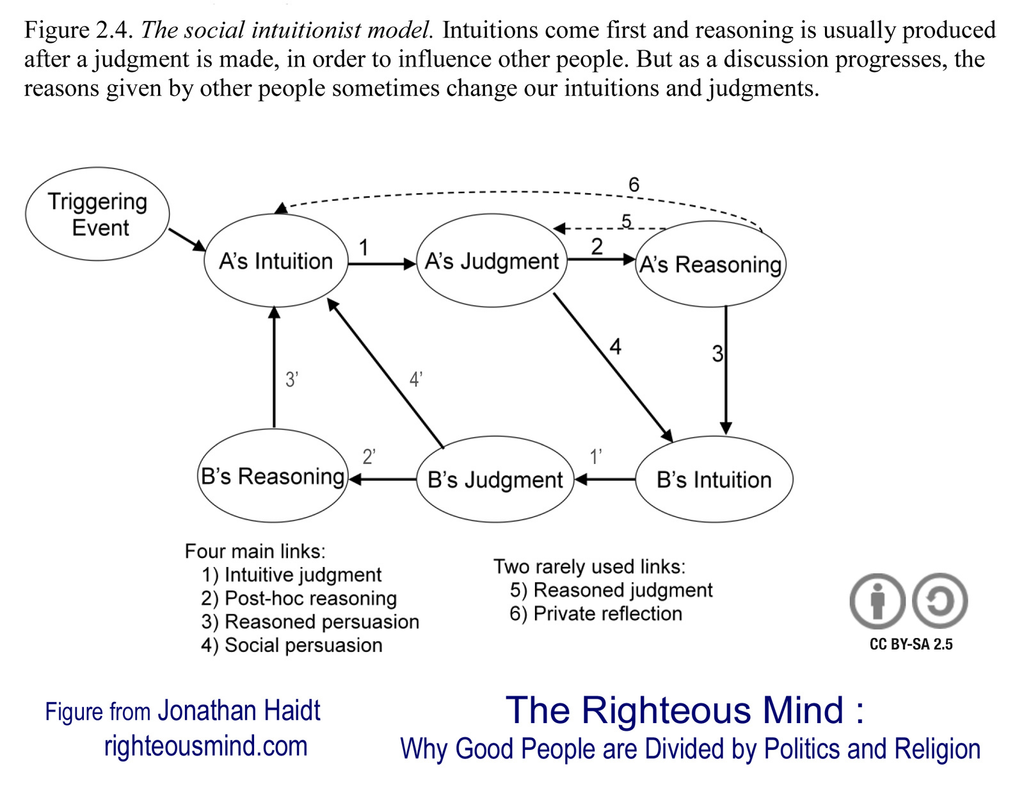
This process is shown in the above diagram where we encounter an event requires us to express, and maybe act upon, a judgement. It could be a moral one such as is it right to steal food in order to stop another from starving, whether slavery or capital punishment is morally right. Or it could be something like whether we trust another person or vote for a particular politician.
Despite how it may seem, the intuitive part of the brain comes to a judgement quickly but it might take us some time to say why we decided as we did if indeed we can say at all.
What perhaps is more disturbing is the way our intuitions can be unconsciously influenced by factors which our reasons would deem irrelevant. For instance, if a person is on trial in a court of law then, all else being equal, they are less likely to be found guilty and given a lighter sentence if they are, if they are attractive.
Although this can seem like the Humean “Reason is (and ought only to be) the slave of the passions” [Hume 1739–40], there are also the influences described as “rarely used” which modify that. As well as the rational aspect of us being used to justify what we have already decided by intuition, reason can change how the intuition can respond to future events. We have the freedom to train out intuitions to respond as we, our minds or spirits, want them to. In that sense our intuition behaves like the autopilot.
In addition there is the influence of others as shown in the lower part of the diagram. We may be reluctant, intentionally or otherwise, to change our intuitive judgement based on our own reason but are more likely to do so based on the judgements of others.
Paul Bloom, in his Nature article, gives the change of morals over time as an example of intuitions being changed by society as a whole.