The Trinity – Father, Son and Holy Spirit
The doctrine of the Trinity, that God is one and yet also three distinct persons, Father, Son and Holy Spirit, is notoriously difficult to understand. In fact it took the Church at least 300 years to come up with a statement of belief about it and even then there were disagreements among the bishops.
It was the Cappadocians: Basil, Gregory Nazianzus and Gregory of Nyssa whose work led to the phrase God is one ousia (essence/substance), three hypostases (persons). And even then, the exact meaning of substance (οὐσία) and persons (ὑποστάσει) were not precise and do not map completely onto the English translations.
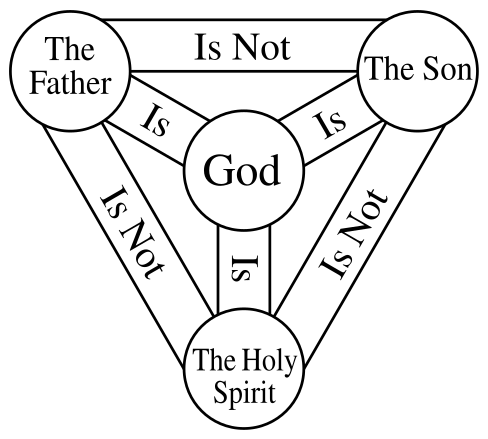
At its heart, the doctrine of the Trinity contains a paradox as shown in the picture.
Father ≠ Son ≠ Spirit
while simultaneously:
Father = God
Son = God
Spirit = God
It appears that this paradox cannot be satisfactorily resolved and has to be taken on authority.
Where did this belief come from?
Although the New Testament does not give a clear statement of the Trinity it contains the material upon which it is based.
- There is one God.
- The Father, Son, and Holy Spirit are each spoken of in ways that seem to belong to God.
- Father, Son, and Spirit are nevertheless distinguishable from one another.
The Father is straight forwardly God. Jesus describes Himself and is described in remarkably strong divine terms but the case for the Holy Spirit being a divine Person is less clear.
There are passages where the Holy Spirit appears to act personally:
- He speaks (Acts 13:2).
- He teaches (John 14:26).
- He testifies (John 15:26).
- He guides (John 16:13).
- He can be grieved (Ephesians 4:30).
- He can be lied to, with lying to the Spirit equated with lying to God (Acts 5:3–4).
And there are triadic formulations such as:
“in the name of the Father and of the Son and of the Holy Spirit”
Matthew 28:19
and Paul’s:
“The grace of the Lord Jesus Christ and the love of God and the fellowship of the Holy Spirit…”
2 Corinthians 13:14
So already in the New Testament there is a Father–Son–Spirit pattern.
But this still leaves open an important question: Is the Holy Spirit actually a distinct divine person, or is “the Spirit” simply God’s own presence, power or activity? In a similar way to the “hand of God” not referring to a distinct Person?
After much debate and consternation, the decisive development came from the three theologians commonly called the Cappadocian Fathers:
- Basil of Caesarea
- Gregory of Nazianzus
- Gregory of Nyssa
They helped articulate the distinction that eventually became standard:
Christianity affirms one God, not three but, in ways not well understood, the three Persons of the Trinity are all simultaneously God.
It is worth noting that in the Shema, where God is declared to be “one”, the word used does not exclude God being three persons. In fact it is the same word that is used when Adam and Eve became “one” flesh. There need be no contraction between “One God” and the Trinity but, equally, there is no support from it either.